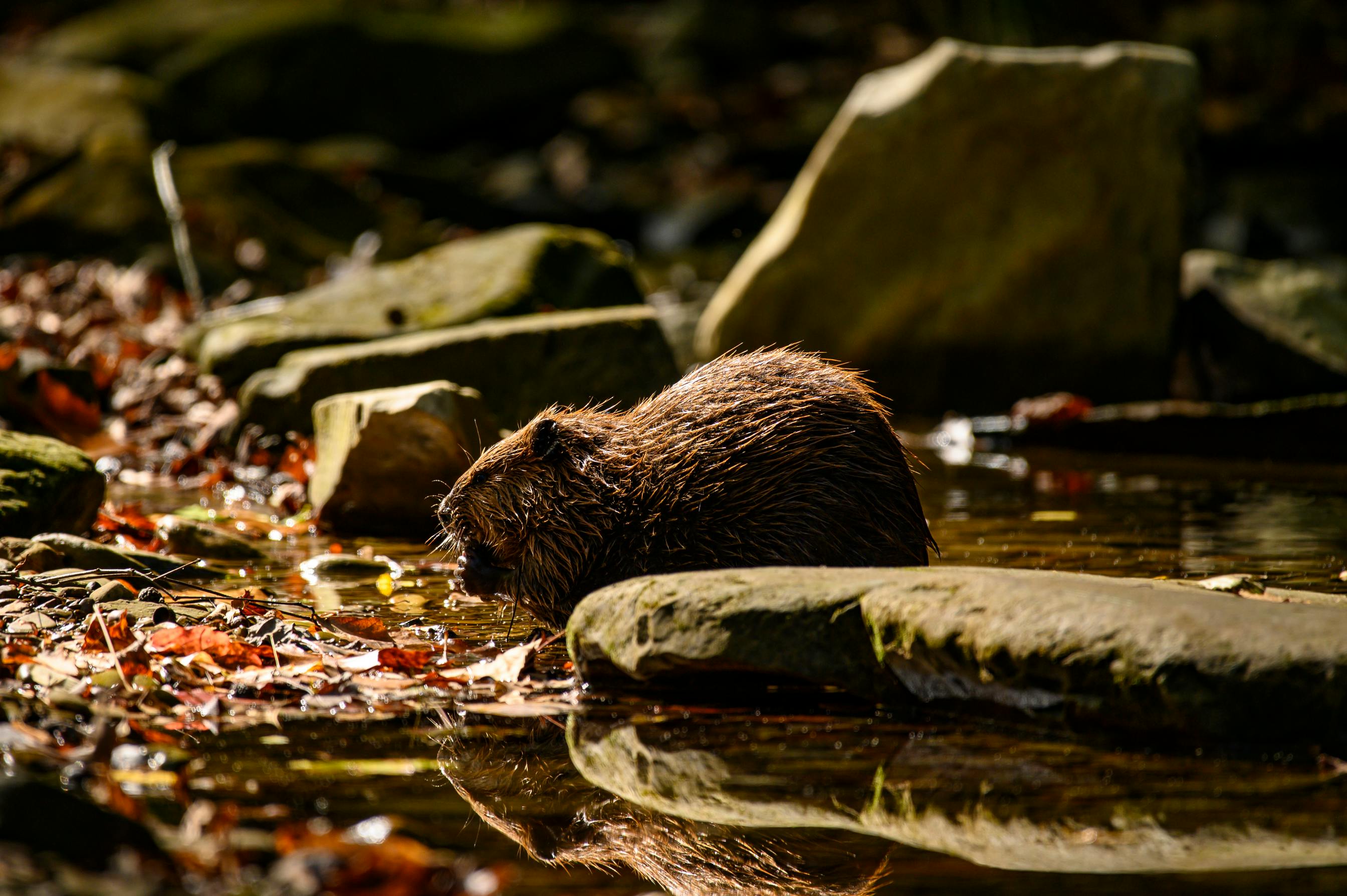
The simple answer: safety
A beaver on dry land is slow, awkward, and tasty. A beaver in deep water is fast, hidden, and almost untouchable. Wolves, coyotes, bears, and big cats all have a hard time catching an animal that can disappear underwater for fifteen minutes at a stretch.
A dam creates that deep water on demand. By blocking a stream, the beaver turns a shallow trickle into a pond deep enough to hide a lodge entrance below the surface. The lodge is the bedroom and nursery; the pond is the moat. No moat, no lodge.
The food problem
Beavers don't hibernate, but they live in places where winters are long and brutal. When the surface of the pond freezes, the beaver still has to eat, and walking around outside on frozen ground is a death sentence.
So they cache food underwater before winter. Branches, twigs, and bark get jammed into the mud near the lodge entrance. As long as the pond stays liquid below the surface ice, the beaver swims out, grabs lunch, and swims back. The dam keeps the water deep enough that it doesn't freeze solid all the way to the bottom.
A dam, in other words, is a pantry.
The strange part: they cannot ignore the sound of running water
This is the part biologists love. Beavers don't really decide to build a dam the way we decide to clean the kitchen. The sound of trickling water is an instinctive trigger. Researchers have placed speakers playing recordings of running streams inside dry concrete pens, and beavers will pile sticks and mud on top of the speaker.
There's no stream there. There's no leak to plug. There's just a sound, and a beaver doing its best to silence it.
It's one of the most direct examples in nature of behavior tied to a single stimulus. The beaver hears the sound, the brain says that needs to stop, and the beaver starts working.
How they actually build
A beaver dam is not a pile. It's a structure.
Layer one: heavier logs and rocks anchored against the streambed. This forms the foundation, set into the current.
Layer two: branches and sticks woven crosswise, jammed into the foundation at angles that lock under the water's pressure rather than against it. The harder the river pushes, the tighter the dam packs.
Layer three: mud, packed by hand, sealing every gap. This is the waterproofing. A beaver patting mud onto a log has the same focus a tile-setter has when grouting.
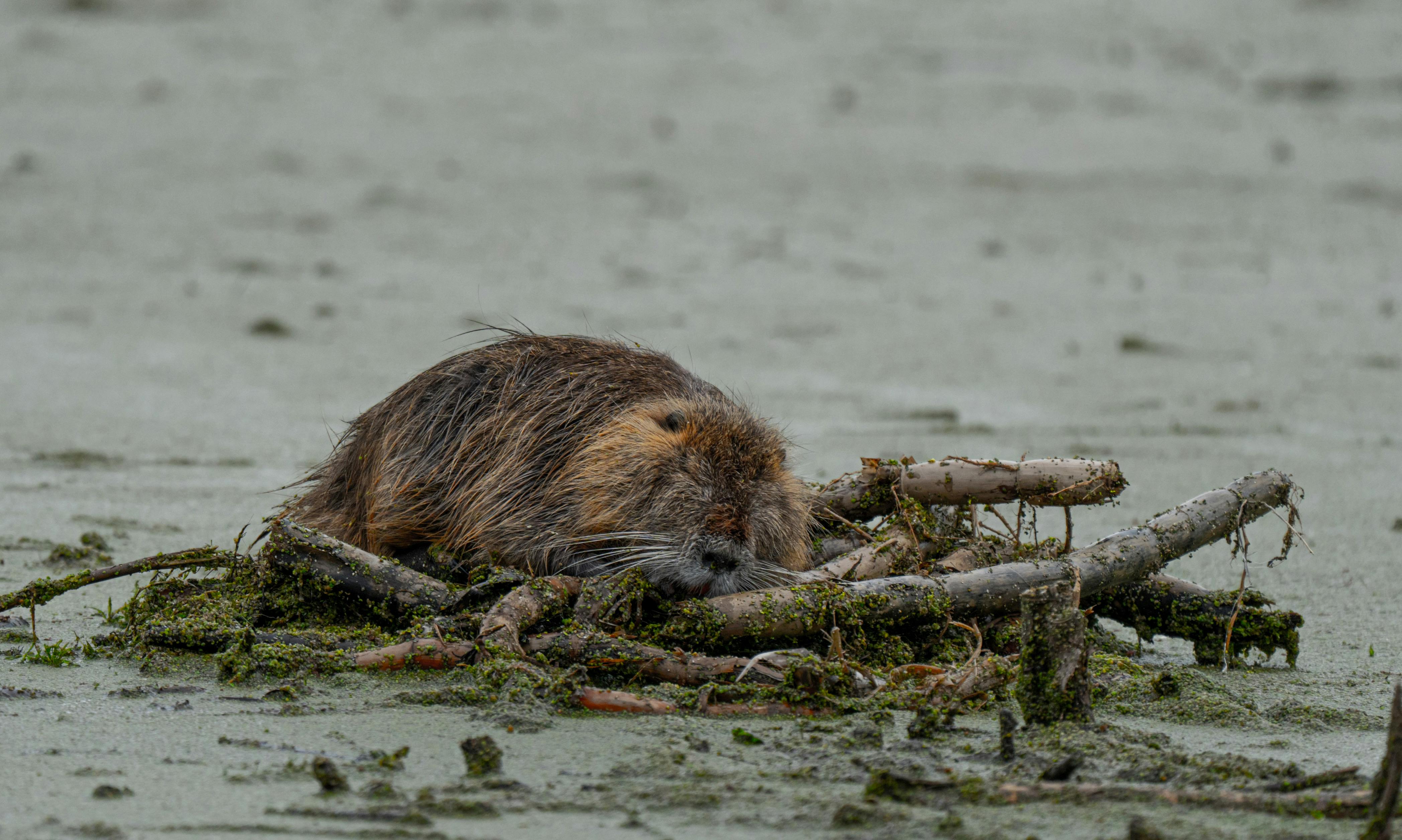
And then they patrol it. Every day. They listen for trickling, find the leak, fix it. A dam left unmaintained falls apart in weeks. A dam that is actively cared for can last fifty years and survive floods that would carry off an unsupervised one.
A family operation
A beaver lodge is a family. The parents do the heavy lifting in the first year of a project, but the kits (born in spring, called yearlings the next year) help out as soon as they're big enough to drag a stick. By age two, they're contributing real labor.
When kits leave to start their own colonies (usually around age three), they take everything they learned about damming with them. Site selection, layering, leak patrol. It's a multi-generational craft passed down by doing.
What changes downstream
A beaver dam doesn't just affect the beaver. It changes everything around it.
The pond floods low ground, killing some trees and creating wetland for everything else: frogs, fish, ducks, herons, otters, moose. Slow water deposits sediment, building soil. Cold water gets trapped, helping salmon and trout. When the pond eventually fills in (over decades), it leaves behind a meadow with extraordinarily rich soil.
Ecologists call beavers a keystone species for this reason. Their work is so foundational that removing beavers from a watershed causes whole ecosystems to collapse, and reintroducing them has been used to restore degraded land in California, Scotland, and Mongolia.
What we can borrow from them
A few things stand out, and they are part of why we built Beave the way we did.
They start with the foundation
A beaver doesn't try to dam a river by throwing a stick into the middle. It anchors the heaviest log first, against the streambed, where the current is strongest. The whole rest of the structure depends on getting that one log right.
Most productivity advice tells you to chase quick wins. Beavers do the opposite. They put the hardest piece in first, when the pressure is greatest, because the foundation only gets harder to lay later.
They build in layers
Logs, then sticks, then mud. Each layer is small. Each layer alone is useless. Together, they hold back a river.
Every focus session you complete is one stick added to your dam. Skip a day, lose nothing big. Stack a week, and suddenly you've redirected the current.
They patrol
A dam is never finished. A leak today, a leak tomorrow, a leak next year. The beaver doesn't get angry at the leak; it patches it and moves on.
Slipped days work the same way. The dam doesn't care about your guilt. It cares about the next stick.
They cannot ignore the sound of running water
This is the part we wish humans could borrow more easily. A beaver can't tune out the trigger. It has to act.
Most procrastination is the opposite: we tune out the signal and find a thousand reasons to do nothing. The work of focus is, in part, the work of getting honest about what we're hearing.
